Saturday, May 25, 2013

Borders on Paradise 2013

Borders on Paradise in Turbotville, PA, traditionally holds the novice classes on Mother’s Day. They run Ranch combined with Nursery first, then Pro-Novice, then Novice-Novice. The Ranch handler’s meeting was at 6:30, so I did not need to be there extremely early, but I had heard that there was a couple hours fog delay on Friday. A friend of mine had run at Borders a few years ago when there was a fog delay, and the order of classes had been flipped around so Novice-Novice ran first. I got nervous about this happening so I made sure to arrive extra-early, though there was no fog, just a cold wind.

I scribed for judge Linda Tesdahl for a few dogs. I nearly always have outer wear for three seasons in the car with me, but for some reason, I did not bring my warmest coat. It was quite cold because of the wind, which was strong, and seemed to rarely let up. Linda finally put on her warm coat and loaned me her fleece jacket to add a third jacket to my layers. It sure helped!

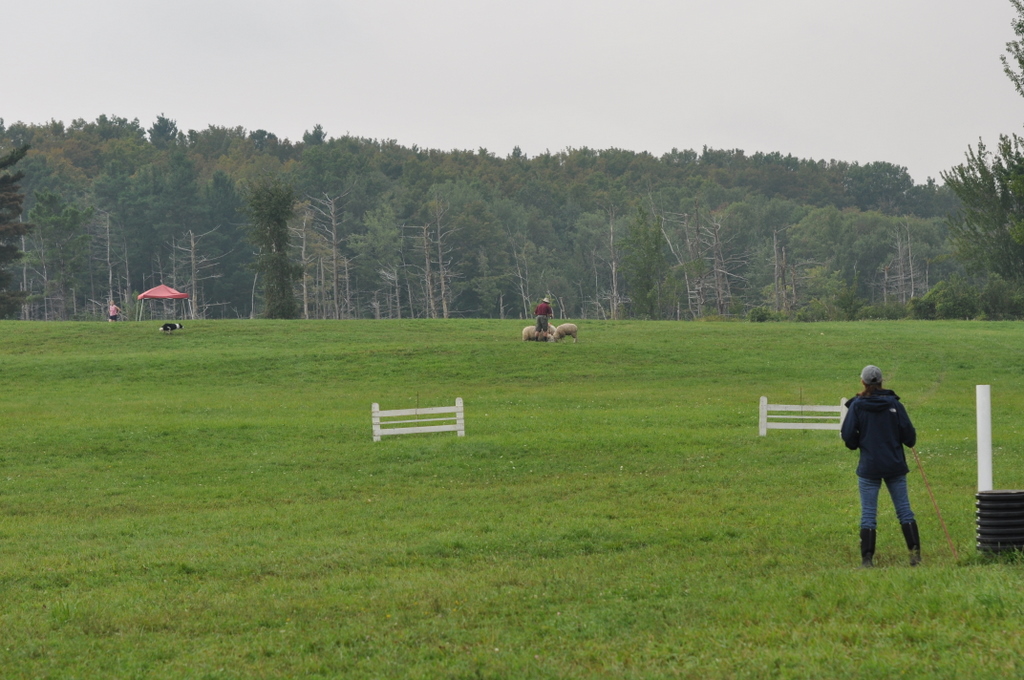
While scribing for Linda, I had a best-seat-in-the-house view of the rough going in Ranch. The sheep here typically run hard for the exhaust—or any other of several gates on the field—and this year was no exception. The holding pen is far up a hill in the top right corner of the field, while the exhaust is to the bottom left. When the set out had been moved down the field to the Pro-Novice distance, the pressure at the top wasn’t quite as bad, but the sheep were still willing to try to beat the set out team to get back to the top. Once they were on the move down the field, it was often a race for them, trying to get to the exhaust. The turn at the post in P-N and N-N was counter clockwise to a right hand drive, and when through the drive panels, turn right (out of the field) back to the pen. There’s a gate on the right hand fenceline that the sheep are familiar with, so the turn out of the drive panels required a quick come-bye flank from the dog to turn them from that gate and fenceline, which had to be followed immediately by a fast, big away flank to cover the exhaust pressure and keep them coming to the pen. All this didn’t bode well for me and my Novice-Novice dogs, though I thought Dot would probably handle them reasonably well as long as I held up my end of things. My sheer jangling nerves had me making funny choices; I went to ask Scott how he thought I might try to handle the top of Seamus’s outrun. An odd thing for me to do, considering Scott hasn’t worked the dog in two years, and had only seen us at one lesson last year. Asking Gene’s input would have been a bit more logical. Either way, all advice probably went in one ear, and out the other at the post.

Dot and I ran about halfway through the class of two dozen dogs that went to the post in Pro-Novice. I sent her to the left, and she went out to the fenceline for a bit, but then came in very flat. I had thought she was deep enough but she probably wasn’t. The sheep had been getting harder to settle throughout the day, and they broke to the right before she was really anywhere close to them. I couldn’t get her around them; she just trailed along behind them as if mesmerized, not taking my many flanks. Finally they started coming towards me; that is, towards the exhaust, but me and the post happened to sort of be in between them and the exhaust. Now I needed to flip Dot around on an away to get them around the post, and the turn was horribly wide. I can't really recall the drive or the panels, but our drive points tell me it was pretty wiggly. The sheep got around the pen at least twice, and time was called. Gene said that my timing was off; that I was asking her to flank or stop too late and too early—probably true. On top of that, I did not feel that we were teamed up very well at all that day. She didn't eat much of her breakfast, which I think is the first time since I've had her that she hasn't finished a meal, so perhaps she didn't feel well, although she seemed perky and normal in every other way. I knew our score would be awful, so I did not even look until there were only about two dogs left to run. The breakdown was Outrun 15, Lift 7, Fetch 5, Drive 13, Pen (T): Total 40 (of 80). Half our points gone; a 40, and some top hands in the class. I knew we wouldn’t be in the ribbons, and when the awards were announced, my mouth was engaged and my brain was not. Then I heard someone say, "Megan, that's you!"—Dave had announced Megan and Dot in 10th place. A real surprise!

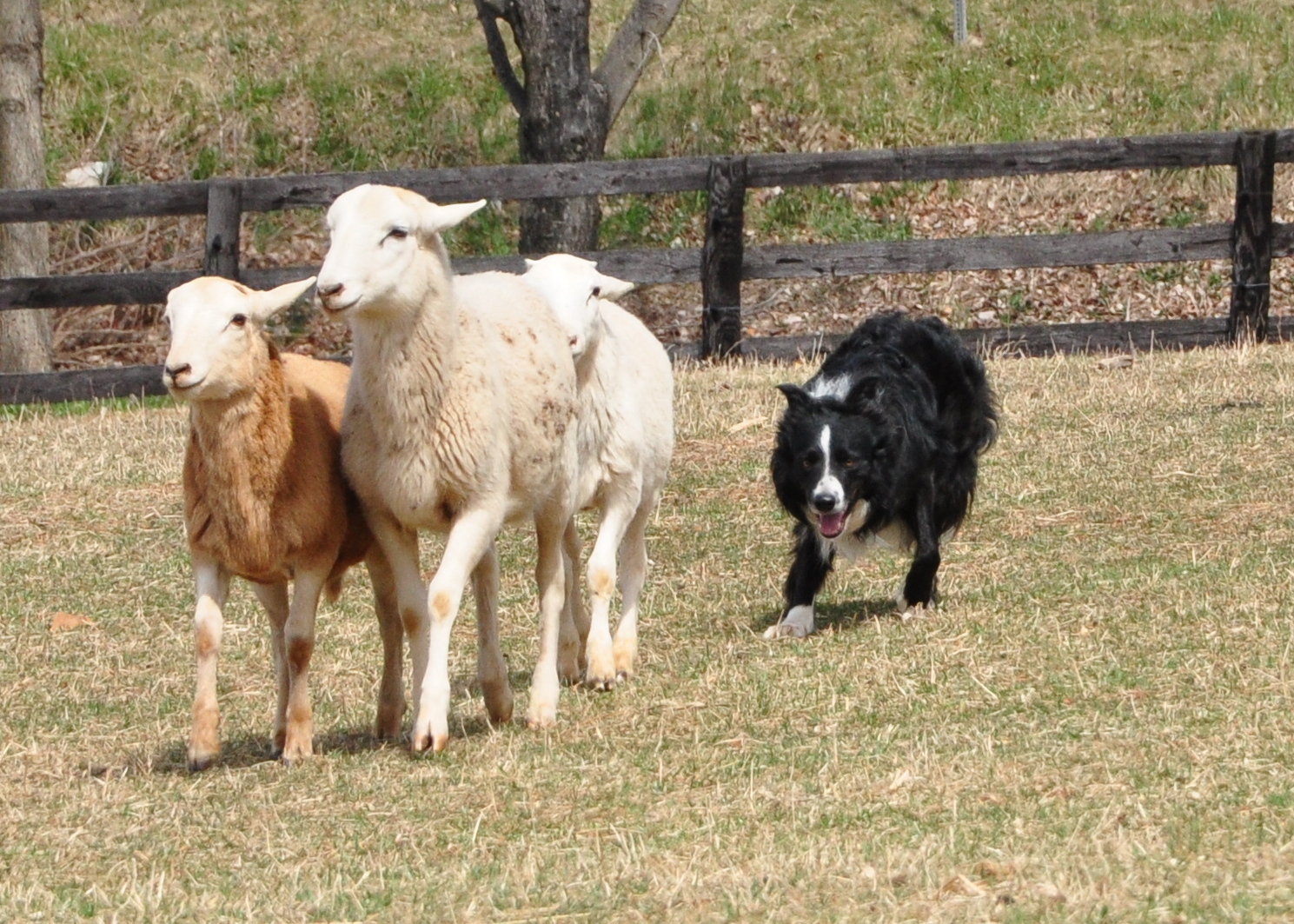
The Novice-Novice class was very small; only five dogs, and two of them were mine. I am very grateful that Dave continues to support the Novice-Novice dogs, when many trials are dropping the class. His sheep and field are pretty difficult for Novice dogs, nearly as tough as Finality, in my opinion: although his sheep are better acquainted with dogs than the Finality sheep, they also like to run, run, RUN!

Seamus was first in the class. I sent Seamus left, despite that being the side where the pressure was, which can cause dogs to be tighter. His right is not nearly as good as his left so I preferred to take my chances. His outrun wasn't great, but I was okay with it. As expected, the lift was a horserace: They were off and running! Here was my first mistake; for some reason, I didn't have my whistle in my mouth (or even out) when he got up to the top of the field. So he was up there, approaching, then lifting, the sheep like a runaway freight train. I had no whistle, and I found myself frozen and tongue-tied! It took me a few heartbeats to even think of at least calling up the field to him as I scrabbled to get my whistle out from under my jacket, but the yelling (and then whistling) didn't matter. There was absolutely NO attempt on his part to lie down or slow down or acknowledge my existence. My original plan was to ensure that he listen to me at the top, even if I had to retire, but I found in that moment that although he was WRONG in his approach to the sheep, once they started zig-zagging, I couldn’t make myself go demand that he lie down while I allowed his sheep to run away. Although he was causing them to zig-zag and run by being too close and pushing on them too fast, he was also trying to control them and prevent them from escaping. Somehow he did manage to straighten them out and they ended up more or less coming directly to me for probably about the second half of the fetch, although they were coming down the field in a hurry. They may have been a bit off line a little to my left, but in my memory, the line wasn’t terribly off. And finally, he lied down…and I made my second big mistake. I thought I'd hold him there a little bit to try to get both him and the sheep a few seconds to settle down, but the sheep had no intentions of stopping just because the dog had stopped; they ran like hell for the exhaust. So I sent him away to try to cover the exhaust, but of course it was already too late. What a stupid mistake, especially because at the core, it was very similar to a mistake I made with him at Finality last year (although I think at Finality I had at least gotten him down while he was behind the post and supposedly should've been able to cover the exhaust). The sheep got down in the corner, and he took them out, but they headed up the rear fenceline (to what was now my left as I faced backwards down the field). He wasn't being bad with them and he was making an effort to get them, but they split and I saw that one was starting to consider really challenging him. I think he has enough courage to deal with it, but for a Novice-Novice class, it was NOT worth it to keep trying, since he was behaving reasonably towards the sheep. I didn't want to risk things getting out of control (having lost them to the exhaust wasn’t in control, but at least he was trying to gather them without getting crazy). I retired him. His outrun was given an 18 and his lift a 7, before our RT.

The fourth team, right before Dare, was my friend Judy with her young dog Finn. They had a VERY nice run, but at the very end while at the pen, two went in and one slipped around the side. She closed the gate on the two, and DQ'd herself. From my point of view it almost looked like maybe she didn't see that the third one was not actually in the pen. She said later that she'd intended to leave it open just the width of one sheep, but that the wind had slammed it shut; it had been very windy all day. I felt so bad for her. It was a very good run, and she really would have deserved the win.

Dare and I were last. She ran out to the left pretty tight. Sheep off and running again, sort of down the field and kind of online, Dare not particularly taking my stops either. We got around the post, and the drive wasn't great. By this time I had made a plan for the turn from the drive panels back to the pen. Because we were turning the sheep right out of the panels, and there was a need to flank come-bye for the turn and then cover the right side of the field, then flank the dog back almost 180 degrees to cover the exhaust, I thought I'd push them through the panels and have her walk up on them just enough to try to turn them right, but not be so close to push them hard to the right. My thought was that if they weren’t moving too fast out of the panels they might not be thinking as much about the gate on the right side fence, and they might pull back to head towards the exhaust. If that worked, then Dare wouldn't be so far out of position as to have to flank far to the come-bye side, then race 180 degrees to the other side to cover the pressure of the exhaust. It was a plan (I so rarely have a plan, other than trying to not have my dogs “punch” the sheep on the lift and chase them down the fetch!), but it didn't work out. The sheep turned right out of the panels but didn't pull back left as I expected, so then I had to try to race Dare clockwise just to catch them, then back counter-clockwise to keep them from getting to the exhaust and headed to the pen.

I try to go to the pen as soon as I can, but I also try not to pick up the rope until I have to, so that I'm not committed to the pen in case there's some way I can help the dog by moving around a bit. But these sheep were running, and I should have run to the pen myself and flung the gate open. I should have taken into account that as soon as Gene could leave the post in his Pro-Novice class, HE ran to the pen. That may have been the first time I have ever seen him run! But I waited too long before realizing I should open the gate, and they went past me. Dare was able to cover the exhaust well enough to prevent an escape, but didn’t get around far enough to pull them back to the pen. They went way behind it, in a big hurry, towards the gate on the right side of the field. She turned on the afterburners and started to chase. Thank goodness she responded and checked herself when I yelled her name! She gathered them, we penned, and we were done. Whew… Outrun 15, Lift 8, Fetch 16, Drive 11, Pen 5. Total 55 (of 80). One other dog completed the course, and with a much lower score; I had retired Seamus, and the other two runs were DQs. So, Dare and I won with a 55, basically by default since my friend had the bad luck mistake. I am happy that Dare and I managed the best run of our class, but I sure hope we can turn in better quality runs this season. We can do nice work; we just seem to defeat ourselves at trials. 


Our next trial is at the PA State Championship in June. I hope that I will be able to get them enough exercise and time out of their crates, as we'll be there helping out several days before our classes, which will likely add to their excitement and stress.


Dot 10th in Pro-Novice, Dare 1st in Novice-Novice


Sunday, April 21, 2013

Spring Cleaning


Our first trial, Borders on Paradise, is three weeks away. I’ve entered Dare and Seamus in Novice-Novice, and Dot in Pro-Novice. Time to tidy up stops and flanks as much as I can. Now that we’re back on Daylight Saving time, we are able to work twice a week. We recently attended a couple of clinics, which were well-timed to give me a bit of concentrated work on the dogs two weekends in a row, then a few weeks of our regular lessons to continue building on the clinic work. The first clinic was with Jack Knox, in Leesburg, Virginia. 

Jack discussing Dot with me. Photo (c)Michelle Dobbs.

I had one working spot for this clinic, but it was a three day clinic so I worked Seamus two days and Dot one day. There are plenty of things for me to work on with Seamus, but I think many of these things come down to pace and feeling the sheep. Overall, he did pretty well; he really likes to work for Jack, and Jack speaks softly and gently to him, unless of course, Seamus lets his excitement get to him, and even in that case, Jack doesn’t need to get too hard with him. I wish I could find that “sweet spot” with Seamus, where I’ve got the nice quiet control. Quiet is better for him (as for most dogs), but there are certainly times when he doesn’t take me seriously, and then it begins; the more I escalate things, the faster he goes and the more anxious he gets and tries to “escape” the pressure. Knowing this (a lesson learned almost two years ago when working with his breeder Tina), I try to stay quiet, but he’s got a fine line between respecting commands and building tension under the pressure of corrections required to rein in his enthusiasm. Even so, he really is making progress compared to a year and a half ago. It’s just coming much more slowly than I’d like. The maturity is helping both of us; he can think a bit more, which helps me to stay calmer, which helps him to stay calmer…etc.

Seamus at the Jack Knox clinic. Photo (c)Michelle Dobbs.

Dot has a tendency of running quite wide on her outruns in the big field at “home,” to the point of being absurdly off-contact from the sheep, so on our first turn at the clinic, I worked her in the largest field to try to demonstrate and get Jack’s input on this. She ran out beautifully; totally appropriately each time, and I was unable to get her to do what I was concerned about. We had a few other smaller things to work on, but no issues with her running too wide. On her next turn I worked her in a smaller field, since there was nothing to be gained by working in the big field. She was just lovely, and Jack seemed to like her quite a bit.

Dot in the big field at the Jack Knox clinic. 
Photo (c)Michelle Dobbs.

Our second clinic was with Kathy Knox in Chestertown, Maryland. I had two working spots here, so Seamus and Dot both got worked over the three days. Kathy remarked on the progress Seamus has made over the time I’ve been working him, and it’s nice to hear that it’s a noticeable improvement. He worked well and tried hard for me the first two days. The morning of the third day, he was a bit rougher; edgier, as Kathy said. The wheels came off a bit that afternoon, where he just couldn’t seem to listen and hear what I was asking, and he was being naughty. Not to the point of chasing the sheep (at least, not that I remember), but being hard and fast and pushy; not stopping when told, not taking flanks or impulsively taking wrong flanks (or so it seemed). I felt like I had the “old” Seamus back. Kathy and one of the attendees of the clinic, whose handling and input I really respect, thought that it could be the effect of more training pressure than usual in such a short period of time (two clinics on back-to-back weekends); it is something they’ve seen in their own dogs. They felt that that Seamus was anticipating training pressure was coming each time we went to the field. I think this could very possibly the case. Still, I am certain he would do much better if I was able to work him more frequently. If I had my own sheep, he could be worked more frequently, but doing real work without as much training pressure. However, having my own sheep is not going to happen in the foreseeable future, so I’ve just got to muddle along as best as I can.

Seamus at the Jack clinic. Photo (c)Michelle Dobbs.

Dot worked very, very nicely for me, and there’s very little to say about it. The main piece of advice was to ensure she’s getting far enough around to cover before her lift, and to steady up the top of her fetch a bit. She generally comes in and lifts nicely, but once they’ve lifted, they come down the fetch quickly, something I’ve not been concerned about because the line is usually good and they aren’t running away, just loping quickly. I also worked at driving and cross-driving, since I have some issues with steering. Dot does everything I ask and this makes my handling errors glaringly obvious. We set out some cones in a rectangle and I stood in the middle and drove her around in both directions. We were also near enough to the holding pens and the other sheep to create a strong draw, which helped make the driving more challenging for me when they were headed in that direction. Kathy liked Dot and thinks she’s a good match for me. I totally agree!

Dot at the Jack clinic. Photo (c)Michelle Dobbs.
There’s one more opportunity for us to tune up before the trial, as there is a nearby fun run trial on May 4. I was planning to enter Dot, Seamus, and Dare, but something has come up at work, and I now may have to work that weekend. I’d be disappointed if I couldn’t make the fun run, but not everything in my life revolves around the dogs. My niece and goddaughter’s First Communion is on May 5 and I may have to miss that, which would be much more disappointing than missing the fun run. Hopefully things will work out.

Sunday, March 31, 2013

Resurrection


Easter seems like as good an excuse as any for a more modest resurrection, that of this blog. It’ll probably be quite some time before anyone notices, because who keeps visiting a “dead” blog? I often feel like the little daily dramas aren’t worth mentioning, and I procrastinate on doing an update, and before I knew it a year and a half had gone by.

Our sheepdog training has continued to the degree which I can afford and for which I have time. For the most part, things are pretty much same old, same old. But naturally, some things have changed.

Dare
Now eight years old, Dare is easily my most trusted and most reliable dog—except at trials! We’ve certainly had our share of struggles along the way, even as recently as the NEBCA Novice Finals last September (2012). While I’ve resigned myself to the fact that she is usually quite nice in most situations other than a trial, at trials we seem to fall apart. We: yes, I take responsibility for some of the trial jitters, too. At the 2012 Novice Finals, things fell apart in a big way when Dare had a relapse of an old bad habit and chased a sheep, which ran into a fence. Fortunately the sheep was fine, but it was nauseating to have that happen. Bad enough for it to happen with a young dog, but positively sickening from a seven year old dog. She works so nicely at our “home” field, and generally quite well at other fields when we are at clinics or working with friends, so it’s not as much the challenge of different fields and different sheep at trials; it’s the entire atmosphere at a trial. 
My instructor teases me and asks when I’m going to move up; we’ve been languishing in Novice-Novice for five trial seasons. I figure if we are so inconsistent as to not have pointed out in all this time—and if she’s still chasing sheep—then I don’t see that we are ready to move up. (In NEBCA novice classes, points are earned based scores awarded at trials. Dogs must move up when they have earned 30 points in a particular class level. They can move up sooner if they are ready.) At “home” we can drive a Ranch course (well, on our good days); we work on shedding, and small turnbacks, but I can’t get her to settle enough at a trial for a decent lift and fetch at a 100 yards or so. Good thing our trial results don’t impact my livelihood! Maybe this will be our year? After all, she’s slowing down, finally…

Branwenn
Branwenn is now five years old. In late 2011, I agonized over her, as she never really partnered up with me when it came to working sheep. At clinics, it was clear to me that these experienced handlers had the timing and presence to get far more out of her than I was ever able to. I considered selling her to either a work or sport home, if I could find a home that I felt very comfortable with, but I had to admit to myself that she doesn’t have the talent that a more an experienced handler would require in a dog, and the amount of handling she requires is not something most novices have. She’s capable of Pro-Novice work, and I would have happily gone on with her just enjoying what we were capable of—after all, I’ve got plenty of limitations of my own!—if only I’d felt that we were a team. 
The decision to stop working her was extremely difficult, but ultimately, I think it was the right thing. I found myself too frustrated with her too much of the time on the field, which I’m sure contributed to her stress level. To be correct, she needs help from the handler, and she wasn’t willing to accept much help from me. As a result of her not taking my help, a moderately challenging situation could get really messy, and so she’d need to be corrected, which she’d generally blow off due to stress. What to do with the dog that needs help but won’t listen to the information being provided, and who earns a correction but can’t handle one? At any rate, I ultimately decided that even if we didn’t work sheep any more together, I truly love Bran too much to be able to let her go. Many dogs have happy and satisfying lives not working stock, and I know this is not the only activity that she enjoys. I have been giving thought to starting a new activity with her, but haven’t made any decisions on that yet. She remains my Sweetpea, and is far and away my most expressive dog.

Seamus
Seamus is technically Bran’s “nephew;” his sire Newby is out of Bran’s dam. Seamus and Bran share some traits, but the sheepdogging journey with Seamus has been quite different to the journey with Bran. He turned three years old in December, and he’s starting to become more thoughtful. Finally, progress there, although there’s certainly a long way to go with him. I’m trusting him more not to lose his mind under stress, and he is trusting me more to ask things of him which may be hard but which I believe he can handle. I’m also becoming somewhat better at how I ask for things or correct him when needed. And of course, as he slowly matures, he’s also more willing to do things at somewhat less than a thousand miles an hour. He still does nearly everything too fast, but there is improvement, and I’m very encouraged by it. 
Although I sometimes feel just barely in control of him at trials, he’s far ahead of where Dare was at this stage in her trial career. By comparison, after one season (plus one trial in 2011), he’s already got more than half the points that Dare has earned in five trial seasons. That’s just one measure of progress, but again, it’s encouraging to me. I continue to try to improve as a handler, and although I still (often!) make stupid novice mistakes, I feel that I’m getting better. Slowly.

Dot
After I had struggled with the decision over what was right to do with Bran, I thought maybe the right thing for me as a handler would be to buy a trained dog. While the other three had been sent out to trainers for several months, they were still essentially just “started” dogs when they came home. Between my lack of mileage and my limited access to sheep, it’s been very difficult for me not only to maintain these young dogs at the level of training they had when they came home, but to actually move forward from there. I enjoy the journey and just working with the dogs, but it’s also true that feeling like I’m not making progress is very discouraging. For example, doing turnbacks with Dare at home is one thing, but running sheep into fences at trials shows me that she’s just not solid. So trying to become a better handler when I don’t feel like I can count on my dog 100% has also made it difficult for me to work on myself as a handler. I quietly mentioned to somebody that I’d be interested in a trained dog, if one fitting most of my criteria came along. A month or two later, I was sent a video of Dot. She was moving along at quite a rapid pace, and she was younger than what I had in mind as a “solid” dog that I could depend on to help me. She’s actually a month younger than Seamus, and I thought to myself, “I’ve already got a fast-moving two-year-old, what do I need another one for?” so I passed on her at that time. About half a year later, a new video of Dot was sent to me, and that got my attention. After probably driving her owner nuts with my many questions (I always have questions, and lots of them!) Dot arrived in New Jersey near the end of July last year. She has been absolutely lovely to work, and all I’d hoped for. She seemed to connect with and feel comfortable with me right away, although the working side of the relationship takes more time to develop. The first time I worked her, a few days after her arrival, my instructor suggested that if she worked just as nice a few days later, perhaps I’d want to enter her in a trial coming up that weekend. She was very good for me, and we were able to get in to the trial, so I ran her after having her just a week and having only worked her twice. It was also my first time ever to the post in Pro-Novice. On our first run on Saturday, we had a bit of a false start; she seemed to get startled by something happening up in the set-out pens just as she passed them, and she turned around and started back. I was able to get her turned around and engaged, but her lift was very slow. Ultimately, we timed out on the drive leg. The next day, we completed the course, and on top of that we even did well enough to place 9th out of 33 dogs. I was ecstatic that she was so willing to work with me so soon!
There’ve been a few challenges with Dot, as well. She’s less social than my other dogs, and I need to keep in mind that she is not comfortable with strangers. I hope that in time, she will feel more at ease. She also had odd movement that resulted in her not being worked for three or four months while we worked on her with cold laser therapy, underwater treadmill sessions to strengthen and condition her, and chiropractic visits. All xrays and exams have come up negative, and the chiropractor seems to be helping, so I am going to continue that with her on a monthly basis for now. She is cleared to work and hopefully the better weather and longer days will enable me to get her more fit, which should help a lot.

#####

I’m really looking forward to doing more with the dogs—all four of them—now that we’re back on Daylight Saving time and the weather is finally getting better. We’ll be heading to several training clinics and trials this season. I can’t wait to visit with our sheepdogging buddies! 


Sunday, September 11, 2011

NEBCA Novice Finals 2011: The Sort-Of-Okay, The Bad, and The Slightly-Better-Than-Bad

What a treat to have my mom accompany me to the trial! I understand how boring it is for most people to watch a sheepdog trial if they aren’t involved with it, but it’s nice to have someone rooting for me under the tent now and then. It also makes some aspects of traveling with three dogs a lot easier when I have help. Thanks, Mom!


Getting the car ready for the day.


The NEBCA Novice Finals were held at Peter VandeCar's High Point Farm in Knox, New York, and judged by Bernie Armata. The classes were Novice/Novice, Pro/Novice, and Ranch. There were three runs for each class; each handler's lowest score was dropped, and placings were determined by the total of their highest two scores. Nov/Nov would run twice on Saturday and once on Sunday. Dare was the only one of my dogs qualified.

The sheep were Dorpers, with a sprinkle of Cheviots mixed in. The Cheviots didn’t want to participate, and the packets which drew two Dorpers and a Cheviot generally had a lot more work to do. Unfortunately, I can not blame the runs on this, as I drew three Dorpers for each of my three runs. I can only imagine how much more ragged still our runs might have been.

Several more experienced handlers took turns setting for the classes, and grain was used to set as well, so in spite of the handlers’ best efforts, the setting was not always even. Some handlers used their dogs quite a bit to hold, moving them till the sheep were still and trying to keep the sheep spotted till the dog on course approached. Others used their dogs to the slightest possible degree, holding mainly with their own presence and the grain. While grain undoubtedly made setting easier for the folks at the top, it often resulted in startled sheep, who were engrossed in grain nearly until the moment dogs were on top of them.

The field as viewed from the post in N/N was mainly level till just before the setout, where a low hill bumped up somewhat steeply, with another rise behind that. Dogs being sent left would encounter two ridges that tended to draw them in flat; dogs being sent right had a more gradual approach, but a large tree was in the path that was probably the most “correct” line for the right hand outrun. Dogs cutting to the inside of the tree would most likely be too tight, so they needed to go to the outside of the tree. I discussed strategy with Gene and debated hard with myself about which way to send Dare. The right was her natural side, but her come-bye had been better in our recent lessons. The exhaust was to the far left at the bottom of the field, and ultimately I decided to send left. We frequently work on a similar hill at Gene’s, and I didn’t feel she’d pull in just for the sake of (possibly) not seeing her sheep. Also, I felt it was very likely that if sent to the right, she would “cheat” on her outrun and stay to the inside of the tree. Either way, I didn’t feel confident that she’d take an out if I tried to widen her. I finally decided that if the sheep either got away on their own or broke away due to her being too tight, it would be much harder to get things fixed if they broke left and headed to the exhaust (as I felt she’d lose her cool and go into chase mode), so I finally settled on sending left. I fretted about it every run, but ended up sending left for all three runs. The turn at the post for Nov/Nov would be counter-clockwise, backwards for the course, which was a left hand drive/wear. This was intended to give the novice dogs a chance to cover that heavy pressure from the exhaust when making the turn.

N/N handler's meeting. L-R: Dan Weeks, Sallie Butler (I think), Bob Holmgren (I think), 
Jean-Louis Bigourdan, not sure (green shirt), Kathryn Acres, Pam Davies, Laurie Place, 
me, Wally Dury, Donna Dickinson.


None of my runs were pretty, but I'll post them all anyway. There's little point in having this blog as a journal for myself if I can't be completely open. All photos and video of me were taken by my mom and are (c)Regina Ireland-Auer. I am very lucky to have any photos at all from Saturday; I goofed big-time after the runs were done for the day, and formatted my camera's memory card (which deletes all photos, usually irretrievably). Kudos to my stepdad, John Auer, who researched the problem for me and suggested I try Pandora Recovery. It was a success, and many photos were saved!


Run 1: The Sort-Of-Okay
Dare leaves on her outrun on a decent path. 
Joe Evans is holding with grain and basically no dog (his dog was way off by the tree on the right hand side, I think). He had them nice and quiet, but they were startled by Dare, 
who came in too flat and too fast. Cindy Schmitt is working push out at the top.

Surprisingly, considering how flat Dare came in at the top, she got around them and they came through the fetch panels. Unfortunately, this was done at warp speed, as with most of her fetches.


At the post. I think I may have been giving her the wrong flank after the fetch panels to try to turn the post the right way (the wrong way at this trial). 
I remember catching myself doing it in one of the runs, but don't remember which one.


Whee! Zig-zagging the sheep all over the place on the assisted drive sure keeps things exciting!


No style whatsoever, but we made the panels.


Heading to the pen. Dare came around too far to the come-bye side when we had to fix the line from our turn, and now she needs to flop around away to the other side to cover the pressure 
from the exhaust to keep them on line to the pen.


 A bit of a bobble as the sheep had beat me to the pen, but not terrible; this photo shows the worst of it. They went back the way they came, and then in. Penning wasn't too bad at the trial, so it's annoying that I forgot to stop them so I could get to the gate first. They'd likely have gone right in. 


"Run away! Run away!"


No smiling! I'd likely have been looking even more miserable if I'd known 
that this would be the best of my three runs.

A 64 (of 80) for our efforts. 


Run 2: The Bad
I tried over and over to make this embedded video a larger size, but Blogger was fighting it (it kept either showing the text of the HTML code, or it would give me an error when saving). 
Sorry it's so small. Perhaps it's best you can't see the details!
Warren Mick holding, I think.


You're probably wondering just what that mess was worth?
(Third from last run; a 50.)


Run 3: The Slightly-Better-Than-Bad
Sunday was supposed to have started with Ranch 2, 
but the fog was so thick we had to wait two hours just to be able to run N/N instead. 
My run was second to last in the class, and by that time, severe weather was imminent. 
It's hard to tell from these photos how really ominous the sky was. Peter had his lightning meter out and was manning the gate to the field to get us on and off quickly. 
He said the field has been struck many times.


Last ditch chance for a respectable run.


Wide enough, but not nearly deep enough. 
You can see one sheep has already startled at her approach, 
in part due to having been occupied with the grain (but also due to the way she came in).
Gene Sheninger holding, Maria Mick doing push out.

The result is that the startled sheep actually lost its footing and fell, while the other two took off down the fetch line. Dare locked in on those two and ignored the other one...and me. I couldn't get her stopped till she almost reached the fetch panels. You can see in my body language that I am dying to run at her right now! Very lucky for me, the single did not jet to the exhaust, 
and I was able to get her to bring it back.


Turning the post the wrong way, which was the right way. 

She'd been pretty bad all weekend on many counts (I wasn't doing much better!), and on the drive leg I got so sick of her not giving the sheep any room, not pacing herself and not taking my "time" or lie downs, that I swished my stick in front of her nose to push her out. 
She moved off a little, but not by much.


Lots more zig-zagging, but we made the panels and had an okay turn. I'm sure someone will say I should be looking at the sheep here, and when making a turn like this, yes, I should be. 
I'm double checking my line to the pen as I forgot what I had picked out as my landmarks! 


When I flanked Dare to cover the exhaust and to stop the sheep so I could get to the pen, she didn't stop where I told her to (not even close), so the sheep beat me to the pen gate again, and I had to have her push them back a little, but we got them in without any trouble. 
Look how close she is here--totally unacceptable, and not tolerated in training.  

Three nights later, Dare had a fever, so it is possible that she just wasn't feeling good at the trial, but she was eating well and I couldn't get her to slow down. NO lethargy, no other signs of illness, so I am not sure I can use Wednesday night's fever explain away our performance on the previous Saturday and Sunday. (58 for our last run.)


When the scores were tallied, we didn't even make it into the top 10. Very disappointing, considering the last time we'd been to the Novice Finals, we were fourth. We didn't run very well;  my disappointment is with us, not with the judging.

Next: A few other runs and scenes from the NEBCA Novice Finals.

Saturday, August 20, 2011

Fetch Gate Farm Benefit Trial

Or, “You Weren’t Thinking of Moving UP, Were You?”

Me? Move out of Novice/Novice? Why do that? I mean, it’s only been four years since my first NEBCA trial. No, I don’t have my own sheep, I don’t think I went to any trials in 2009, and just one in 2010, so we haven’t exactly been racking up tons of trial experience. But still, we’ve been out to work at other fields--including all those miles to Colorado and back--and attended our share of clinics, so it’s not like we never leave our “home” field. It’s really time to get moving up; and yet I can’t seem to get it together with Dare out on the trial field. I get extremely nervous about trials, and no doubt I transmit some of that to Dare, but even so, I know we can do better than we have been doing. There doesn’t seem to be any point to moving up unless we are consistently doing reasonably well in our current class, because once we move up, there’s no going back.

Fetch Gate Farm's Benefit trial was Novice classes only; Nov/Nov, Pro/Nov, and Ranch, and was a benefit for their big trial in July. I’m so glad that Heather and Roger Millen are willing to have Novice/Novice handlers and dogs at their great trials, and I was happy to be able to attend, support the trial, and get more experience.

The trial was August 13-14, and the judge was Ron McGettigan. I entered Dare, but barely considered entering Seamus. He’s still quite young, and we have so much to work on. It didn’t seem worth it to rush him into a trial. However, Gene said that Ron is great for helping novice handlers and young dogs gain experience, and encouraged me to enter him; Heather echoed the sentiment, so I sent off an entry for Seamus. We’d been to Sheep Camp at the Millens’ in June, and I thought having been on the field before might help Seamus a little, too.

Seamus has had issues with his away side outrun since I got him back from Scott; that is, he was going fine with Scott or with me when I worked with Scott, but when Scott was out of the picture, Seamus’s weak areas started to become more evident. He doesn’t like to run out to the right, and at first he would run straight up the field, my “Lie down!” and “Whatareyoudoinginthere!!” seeming to do nothing but spur him on faster and with more determination to get to them. After a Come to Jesus meeting…or two…he finally took me more seriously. He started at least trying. He’d run out slowly, with his head turned in on the sheep, and stop, usually turning to look at me. I’d tell him to get out, and he’d carry on a ways, and stop again. He’d stop two or three times on the way out. Of course I didn’t want him to develop a habit of stopping, but for the moment, this was a much less serious infraction than running straight at the sheep with intentions to chase them all over the place. We were working on this from lesson to lesson, and one day as I walked him into the field, he saw Gene bringing the sheep out from the woods, past a pen to our right, where there was also another packet of sheep. Seamus then decided he’d go look for sheep in the woods, or in the pen, even though he was looking right at Gene and our set of sheep who’d just walked past us. On another day, Gene had the sheep settled at the top before we got to the "post." Shadows were falling across the top half of the field were the sheep were, so it may have been harder for him to see them, but he just didn’t see them at all, and kept trying to go to the woods to look for them again. All these little hiccups, yet I decided to add more to the training stew, and asked Gene to start holding the sheep further out, so I could start lengthening his outruns again. He was going out well for Scott, but in trying to get a handle on his issues, we’d been working fairly short distances of 100 yards or sometimes considerably less. With all these recent challenges, I had some concerns about how his outrun would go at the trial, but hoped that having been on the field before and the sheep being up on a hill in front of us would help him see and get to them. If I could get him to his sheep at the trial, and he didn’t break them apart, I’d be happy.

Dare had been working well, overall. Her outruns were generally good, and she’d been driving pretty well; in fact we’d been driving Ranch course distances in the last few weeks. I’d made plenty of handling mistakes causing missed panels and crooked lines, but she’d generally done all I’d asked of her. I had hope that we might do better than our last outings at PA State (Hop Bottom) and Borders on Paradise (where we placed 3rd out of a small class of 11 or 12 dogs; although we were 3rd, I felt the quality of our work wasn’t what it should have been).

The trial was well-attended, and had the largest number of dogs I've seen in a Novice/Novice class except for Hop Bottom. There were 27 dogs on Saturday and 29 on Sunday. I was surprised and pleased to learn that Gene was setting for N/N, which in addition to the familiar field was a nice little bonus for Seamus to lift off a familiar person. The setout for the class was quite far for N/N; close to 160 yards, up a hill. Gene and I were both glad we'd been asking Seamus to go further recently!

My first dog up on Saturday was Dare, early in the running order. She ran out a bit tight and not quite deep enough, pushed in and broke them apart on the fetch and started to chase (but surprisingly, listened to me when I yelled for her to stop), and got them around the post. We did an assisted drive but missed the panels at the last minute because she didn't do as I asked, and we managed an okay pen. They were pretty easy to pen and it should have been a "gimme" but she wasn't quite right so we got dinged for a point off. We ended up with a 50 out of 80, and I think that put us 13th.

Seamus ran near the end of the class. He went out to the right slowly and with his head turned in. I was SO close to giving him a flank or an out to encourage him along; I was almost literally biting my tongue not to say anything. I'd have to give him a redirect if he stopped, but realized in time that I’d take points away from myself that I didn't need to if I pushed him on before he stopped. I managed to keep my mouth shut, my little dog got himself all the way up and around them, and he ended up with a 20 point outrun! He turned in at the right place, but after he got them moving it was a race and they pulled hard to the right, and he was quite excited. Still, we got them down the field as far as the post but in trying to get around it, he wouldn't quite listen and had them jiggered up, so ultimately lost one and then they all ran to the exhaust corner. The judge had told us that if they got to the exhaust, we'd have one chance to get them out of the corner, but if it was a mess or if they got away a second time, that would be it for the run. Seamus had no intention of doing it nicely and ran one along the fenceline, so I retired. I wasn't happy that the run ended in the corner, but I was very happy he got out around his sheep without stopping or redirects.

Saturday Novice/Novice scores.

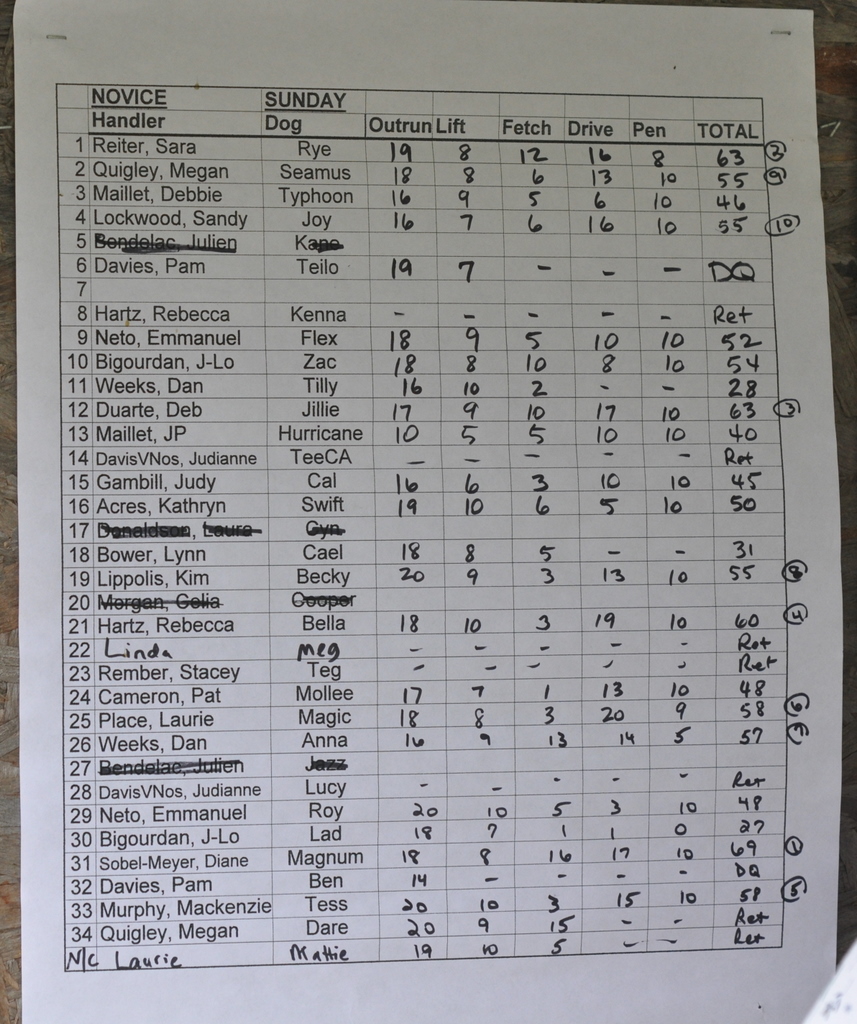
The sheep were difficult about the pressure on the field to begin with on Saturday, because the'd been used for four days at the Sheep Camp clinic in June, then for a four-day trial in early July, and now for a two-day trial in August, so by Sunday they were pretty bad. Seamus was very early in the Sunday running order. He went out all the way again without stopping, but didn't go out quite so well this time and came in fast at the top. He got them to me but it was very ragged, and we got around the course in a hurry-up-and-stop kind of manner. It was not pretty but he was at least making an effort to be a team player, and we got all the way around. He was going way too fast all the time. He earned an 18 on outrun, 8 on lift, 6 fetch, 13 for the wear, and a 10 point pen, for a total of 55. There were three 55s and his outwork was in the middle of the three, placing us 9th of the 29 dogs. I certainly didn't expect to place with him, but he was the only one to come home with a ribbon!

Sharon Nunan was kind enough to take photos of both my runs on Sunday, however, I'd messed up the focus setting on my camera and didn't know how to fix it. Out of focus shots are not Sharon's fault.
Here's Seamus on his Sunday fetch, sort of covering.
He got them to me instead of letting them get to the exhaust, so I guess that counts as covering the pressure, but they traveled a lot further than the 160 yards or so.

Seamus coming around hard at the post to cover the pressure of the exhaust.
Photo by Sharon Nunan.
 
Trying to get things sorted out at the post.
Dog and handler are both in the wrong spot...especially the handler. Photo by Sharon.
 
I was trying to pay more attention to what my sheep were doing and not be so focused on my dog, however, I should have been paying attention to him here.
I’m lucky they didn’t squirt left in front of the panels. Photo by Sharon.

 And the return leg, heading to the pen. Not a good line, but least he covered. Photo by Sharon.

Into the pen, and he’s right where he should be. Photo by Sharon.
 
Good boy! Notice he’s not trying to run after the sheep who are bolting
towards the exhaust after being let out of the pen. J Photo by Sharon.

Dare's second run was near the end of the running order, and wasn't pretty. I was surprised to see that she’d earned a 20 point outrun, because as she went out I didn’t think it was as good as the previous day, and I didn’t notice the sheep trying to get away from the setout or anything that would have given us a “default” 20. Her outrun isn’t her best attribute so I’ll take a 20 when I can get it! Got them down the field and though she's usually a pretty good listener--at least at-hand!--I couldn't get into her head and we made mess as we were trying to turn the post to start an assisted drive. I was also not in the best place at the post for these sheep, so between my unfavorable position and her state of mind, we ended up pushing the sheep slightly back in front of the post and then across the fetch line to the wrong side. I couldn't get her to do as I asked and in trying to fix where the sheep were, they ended up going completely around the post the wrong way. Then as I tried to push them back, she came in too hard on them, split them up, and chased, so I retired. That's the sort of thing I expected from my young dog, not the 6 year old dog. I have my bad days too and make plenty of mistakes, so I guess it would be fair of me to accept that she just couldn't do it that day, but I admit it was disappointing as she’d been working better than that. I guess that's the typical trialer's lament: "She's working great at home!"

Dare kind of covering the pressure on the fetch (they are offline to the right). Photo by Sharon.

Dare walking up on them near the post. I’m not in the right spot to make things better.
Photo by Sharon.

I don't think she actually gripped, but she was still A Very Bad Dog. Photo by Sharon.

 Sunday Novice/Novice scores.

Dare is qualified for the NEBCA Novice Finals, which is over Labor Day weekend. I'll spend the next few weeks working on the issues we’ve had at trials this season, and continuing to get a handle on Seamus.

Next: NEBCA Novice Finals.

A few more photos from the trial, taken by my with the screwed-up camera settings. Full results are available for a little while at the NEBCA Trial Schedule page.

Diane Sobel-Meyer’s Aussie Magnum on Saturday. Magnum won the class on Sunday.

Gene Sheninger’s Teg driving in Saturday’s Pro/Novice.

Mackenzie Murphy and Hemp in Saturday’s P/N.

Cindy Schmitt’s Imp. Jaff in P/N on Saturday. They placed 9th.

Peggy Chute’s KC working the pen in Ranch on Saturday, where they placed 4th.

Judy Gambill’s Tweed waiting to be sent for his Saturday Ranch outrun.

Heather Millen and Chip turning the post in P/N on Sunday.
They had a beautiful run but timed out a few seconds before the pen.
Chip is Dare's nephew; he is a grandson of Perky.

Sharon Nunan and Will head to the post for their Sunday P/N run.

Will fetching to Sharon.

Will doing a fast flank to fix the drive line. The P/N drive gates are the red ones.